Your data
Aggregations
Reports, counts and grouped data computed by MongoDB: define a pipeline once in the console, test it, and call it from your app by name.
Sales by region, orders by status, the ten most active users: that is an aggregation, a pipeline of MongoDB stages that MongoDB runs for you. You define it once under Aggregations, give it a name, and your app calls it by that name. The app never sends a query, so it can only run what you approved, and the logic lives in one place for every client.
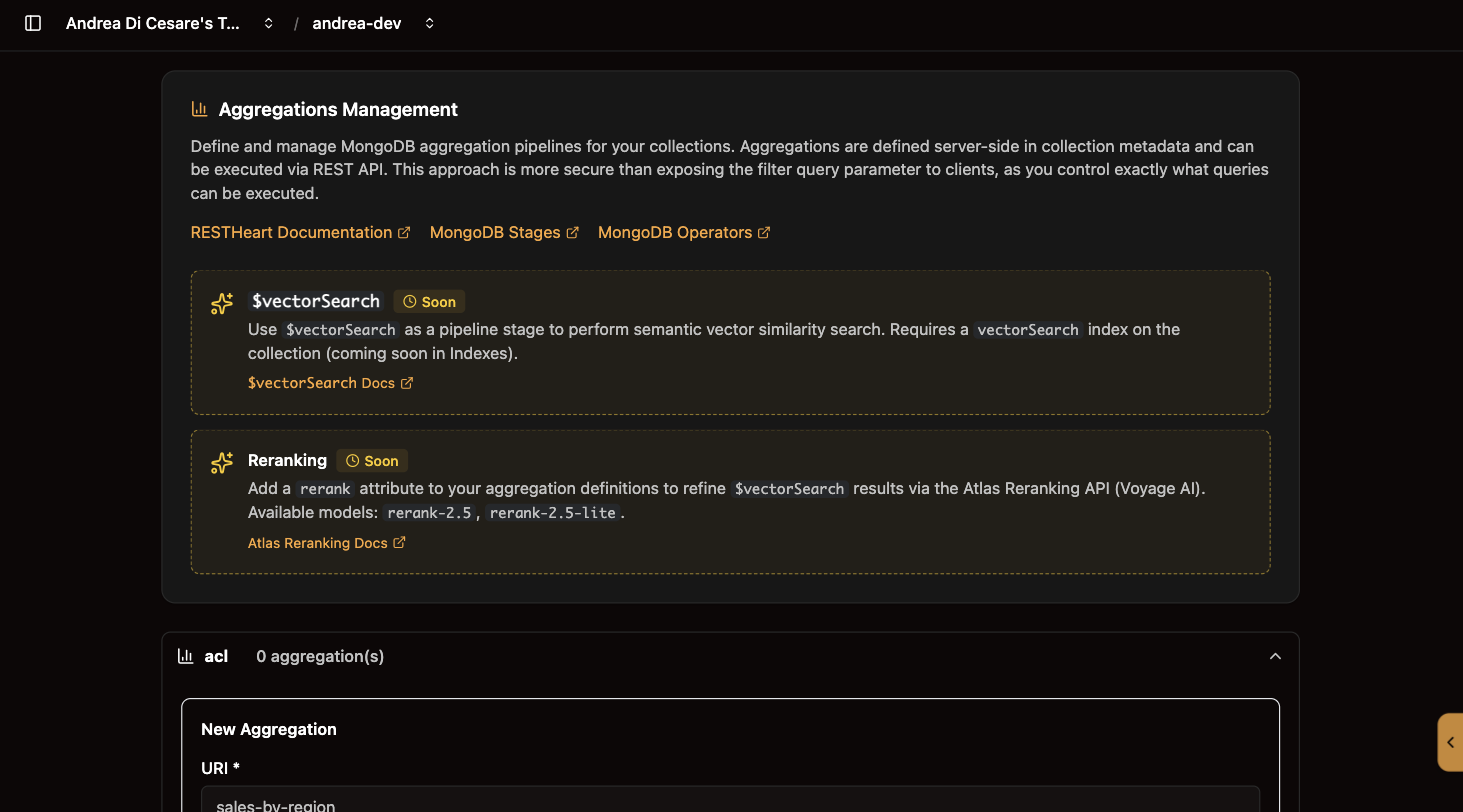
Define one
-
Open Aggregations and expand the collection.
-
Click Add Aggregation.
-
Give it a uri: the name it will be called by, unique in the collection.
sales-by-region,count-by-status. -
Write the stages: the pipeline, as a JSON array.
-
Test, beside Create or Save, shows what it returns; then save it.
[
  { "$match": { "status": "completed" } },
  { "$group": { "_id": "$region", "total": { "$sum": "$amount" } } },
  { "$sort": { "total": -1 } }
]
The editor helps: Add template starts you off, Add pagination appends $skip and $limit stages driven by parameters, and Format tidies the JSON and points at a mistake. Test executes the pipeline against the collection as it stands, before you save, with the service’s own security checks. It refuses $out and $merge, so it can look but not write.
Saving takes effect at once. The uri cannot be changed afterwards, since it is part of the address your app calls; the stages can.
Rerank the results
With a reranking model set under AI Keys, the form has a Rerank section: tick it, name the query variable (q by default, the parameter that carries the question) and, if you want, how many results to keep. The service hands what the pipeline returns to the model, which reorders it by how well each result answers the question. The model reads each result’s text field, or the whole document when there is none, so add a $set stage that copies the field to judge by into text. See Reranking a search.
Call it from your app
GET /<collection>/_aggrs/<uri>?page=1&pagesize=20const res = await fetch('https://c0ffee.ulabase.app/orders/_aggrs/sales-by-region', {
headers: { Authorization: 'Basic ' + btoa('alice:secret') }
});
const rows = await res.json();The user needs a permission that allows GET on that path, like any other read. Results are paged with page and pagesize.
Parameters
A pipeline can read values from the request with $var, so one definition serves many questions:
[
  { "$match": { "region": { "$var": "region" }, "amount": { "$gt": { "$var": "minAmount" } } } },
  { "$count": "total" }
]
The app passes each one as a query parameter of the same name:
const res = await fetch('https://c0ffee.ulabase.app/orders/_aggrs/sales-by-region?region=europe&minAmount=1000');A value that looks like JSON is read as JSON: ?tags=[1,2,3] binds an array, ?opts={"limit":10} an object. Anything else is taken as a string, so a bare word needs no quoting.
One kind of variable cannot travel this way: the one whose name is a query parameter the service reads itself, page, sort, filter, keys and the like, which would never reach the pipeline. For those, and for a service older than 9.9, there is the older form: one avars object holding them all.
const avars = encodeURIComponent(JSON.stringify({ sort: { date: -1 } }));
const res = await fetch(`https://c0ffee.ulabase.app/orders/_aggrs/sales-by-region?avars=${avars}`);
Both forms work together in one request, and avars wins if it carries the same name.
In the editor, when the pipeline uses $var, a Parameters for the run box appears. Fill in the ones this pipeline uses writes the skeleton with every name the pipeline reads. $ifvar includes a stage only when a parameter is present; the editor’s Variables and optional stages panel shows both with the predefined names.
Large pipelines
MongoDB gives a pipeline 100 MB of memory. A $group or $sort over millions of documents can exceed it and fail. Turn on allowDiskUse for that pipeline and MongoDB spills to disk instead. Before you do, add an index on the fields your $match and $sort stages use: it usually removes the need.
From a script
Aggregations are stored in the collection’s metadata, in the aggrs array, so a script writes them with the rest of the collection’s settings:
| Operation | API |
|---|---|
Read the definitions |
|
Save them |
|
Run one |
|
With ulabase, they are part of the setup file.
Related pages
-
Constraints: the same pipeline editor, used to write rules a write cannot break.
-
MCP server: an aggregation you publish becomes a tool an AI agent can call.
-
Permissions: who may call which aggregation.